
Century Legend
Century Legend ship overview

Launched
2013
Tonnage
12,516
Length
139
Crew
140
Capacity
396
Facilities
Activities and Services
Food & Drink
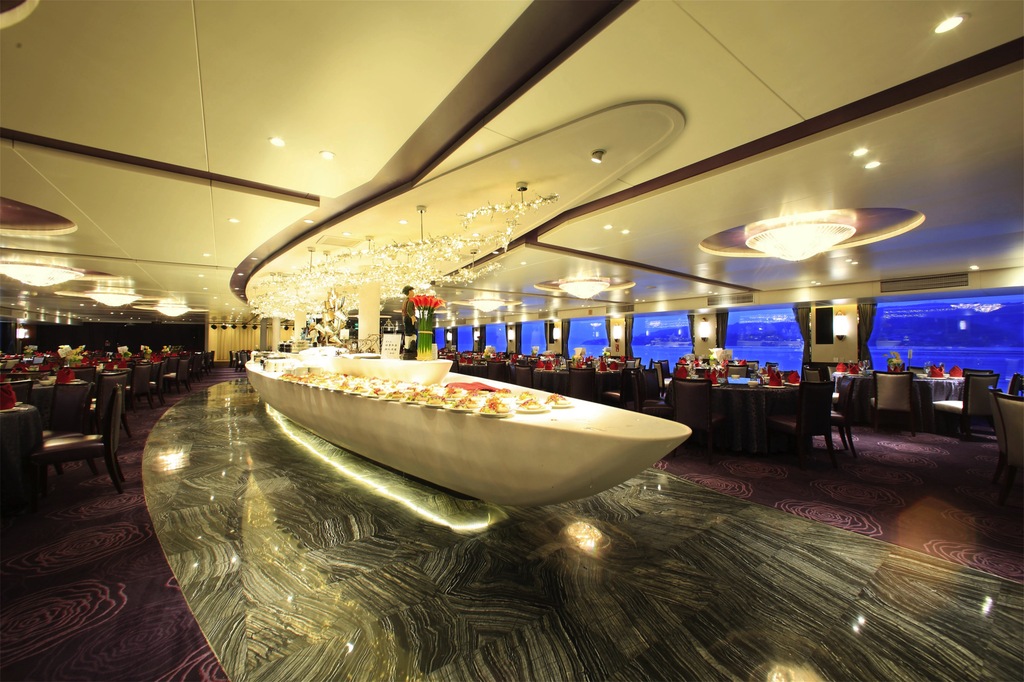
Main Restaurant
Entertainment
Cheers Bar & Lounge
For refreshments, the Cheers bar and lounge serves tea and coffee during the day and transforms into a stylish cocktail spot in the evening. Some executive suites are located on the observation deck.
Sun Deck
The sun deck features a spacious open-air deck at the bow of the ship, complete with sun loungers – it’s the perfect place to watch the scenery change along the riverbanks. Inside, you’ll find a quiet spot to read in the library, or, for a more active activity, you can work up a sweat in the onboard gym.
As evening sets in, our VIP restaurant – provides a more exclusive setting for dinner, buffet style (included at no extra charge for suite guests).
Gift Shop
Bridge Deck is home to a selection of deluxe cabins. It also features a selection of gift shops, perfect for browsing souvenirs.
Internet Service Centre
More information coming soon.
Photo Studio
More information coming soon.
Observation Deck
The place to go for entertainment and leisure facilities, the observation deck is home to the entertainment hall, complete with a dancefloor – it’s the perfect place to unwind after a day of exploration.
Fitness
Onboard Spa
Designed with wellness and relaxation in mind, the Main Deck features the onboard spa, where guests can book a variety of treatments (fees apply).
Enrichment
10 things to do in China
Walk along the Great Wall, Beijing: Starting with an experience on everyone’s bucket list, The Great Wall of China is one of the most famous structures on the planet. Despite its name, when you’re up close to the wall, you’ll notice it’s not actually a wall but a series of beacons, towers, barriers, barracks, garrisons and fortresses forming one of the most impressive defensive systems in history.
Avoiding the most popular sections of the Great Wall, especially Badaling, opt instead to see this incredible architectural feat in Mutianyu, which is easy to do in half a day from Beijing. This is one of the best-preserved sections of the 20,000 km structure and one of the most densely populated with watchtowers. They make a great vantage point to look out over the surrounding countryside and take in the area’s natural beauty.
Visit Tiananmen Square, Beijing: Located in the heart of Beijing, Tiananmen Square is one of the largest public squares in the world (although, if we’re being pedantic, it is, in fact, a rectangle!) with historical, cultural and political significance. Through the years, this square has seen many significant events, including the proclamation of the founding of the People’s Republic of China in 1949 and the protests (and subsequent massacre) of 1989 – rumour has it you can still find a bullet hole on one of the four marble lions in front of the Tiananmen Gate.
Today, there are many sites to explore on your visit from Tiananmen Tower to the Monument to the People’s Hero and Chairman Mao Zedong Memorial Hall. If you’re up before the sun, you can join the crowds to watch the raising of the flag ceremony, or you could stay to watch them lower it at the end of the day.
It’s also known as the ‘front door’ to the Forbidden City, our next must-see!
Explore Forbidden City, Beijing: Just off Tiananmen Square is the Forbidden City. This astounding complex is the largest imperial palace in the world, with more than 90 palace compounds, surrounded by a wide moat – it’s essentially a micro-city within its own right. After its completion in 1420, the city was home to 24 emperors during the Ming and Qing dynasties. The last occupant, the last emperor of imperial China, Puyi, was expelled from the precinct in 1925, at which point the complex became a gigantic museum. Spread over 250 acres, the horizon is a sea of curved eaves with yellow-glazed titles and vibrant red walls. As you’d expect from the seat of supreme power in China for over five centuries, it’s incredibly impressive.
Wander through the gardens of Summer Palace, Beijing: This UNESCO World Heritage Site was first built in 1750 and was a casualty of war in 1860 – destroyed by the British to avenge the deaths of several British envoys – and restored on its original foundations in 1886. Said to be the best-preserved imperial garden in the world, the Summer Palace is the largest of its kind in China. It may be just a stone’s throw from the centre of Beijing, but you’ll feel a million miles away in the serene gardens.
The Summer Palace was the summer resort for the Qing dynasty’s royal family, with beautiful gardens and airy pavilions – the complete opposite of the imposing Forbidden City. Kunming Lake covers three-quarters of the gardens; the rest is undulating hills and gardens punctuated by ornate structures, like the Tower of Buddhist Incense, the Hall of Dispelling Clouds and the Long Corridor – which holds a Guinness World Record for the longest covered wooden corridor in the world. The gardens are the perfect place to spend a day in the sunshine.
Marvel at the craftsmanship of the Terracotta Army, Xi’an: One of the greatest archaeological discoveries in modern times, the Terracotta Army, was unearthed in 1974 by farmers digging a well, just half an hour’s drive from Xi’an. Over the past 50 years, archaeologists have located 600 pits filled with rows and rows of figures, weapons and clay horses pulling wooden chariots. Look closely and you’ll see each face appear unique, revealing a high level of craftsmanship and artistry. From this incredible discovery, historians have uncovered more information about daily life during the Qin dynasty.
Meet the residents of Chengdu Research Base of Giant Panda Breeding, Chengdu: Giant pandas aren’t just the country’s ‘National Treasure’, but a favourite worldwide so, of course, you can’t visit China without seeing the wildlife. And there’s no better place to do that than Chengdu Research Base of Giant Panda Breeding. The world’s only centre that focuses entirely on the critically endangered giant panda. Home to nearly 120 giant pandas and over 70 red pandas, the base focuses on breeding – which usually takes place between March to May – and by early autumn, you’ll see tiny newborns in the nursery incubators. Top tip: pandas are notoriously lazy – they spend most of the afternoon napping (it must be nice to be a panda!) – so be sure to visit in the morning when they’re most active.
Ride the Bullet Train: While travelling between the cities that make up China’s ‘Golden Triangle’, the right transport is crucial. But travelling on their high-speed trains isn’t just a necessity, it’s a pleasure. The ride is so smooth you can move about with ease – even during acceleration and deceleration. It’s fast. And you get to see more of the countryside whizzing by from the train’s window.
Delve underground in Reed Flute Caves, Guilin: Although formed over 180 million years ago, Reed Flute Cave was only officially opened to the public in 1962, quickly gaining notoriety for its beauty the world over – even two former US Presidents (Nixon and Carter) have visited the caves.
Named for the reeds that grow at the mouth of the cave, Reed Flute Cave is a natural wonder. Karst caves, filled with a dazzling array of stalactites and stalagmites backlit by colourful lights, give the cave an otherworldly feel. Inside is an underground lake fed by the gentle trickle of a stream which flows through the cave system. Not content to only be a site of natural beauty, there’s plenty of history to uncover here too with more than 70 ancient inscriptions dating back to the Tang Dynasty – including travelogues and poems – providing insight into the history of the cave.
Cruise through the Guilin Li River Scenic Area, Guilin: The Lijiang River Scenic Area is one of China’s most beautiful natural landscapes. Snaking past ancient villages, farmers tending to their crops in fields, swaying bamboo groves and even buffalo cooling along the riverbanks, a cruise along Li River is the best way to appreciate the scenery. These sights have also been immortalised on the back of the 20RMB banknote. From flat rice paddies sprout a procession of jutting limestone karsts with bizarre names and intriguing legends – it’s no wonder why Chinese painters and poets have celebrated these scenes for generations. Top Tip: Look out for some of the highlights of this journey. The karst peaks, known as the ‘Nine Horses Fresco Hill’, where the mountains are said to resemble galloping horses.
Enjoy the beauty of Yuyuan Garden, Shanghai: Founded by the Pan family – rich officials from the Ming dynasty – Yuyuan Garden features shaded alcoves, glittering pools churning with fish, pavilions and pines sprouting wistfully from rockeries. The gardens are now an attraction for any visitors looking to see classical Chinese architecture and exquisite sculptures and carvings. As you wander the winding pathways, you’ll stumble on decorative halls, elaborate pavilions and pagodas, as well as zig-zagging bridges that cross glittering pools.
Next door is the Yuyuan Bazaar, the perfect place to stop for a snack – fuel for an afternoon spent browsing the traditional Chinese commodities: Chinese lanterns, decorations, silks, arts, jewels and more.
PS Don’t forget the food!
While Chinese food has been popular in the UK since the mid-1900s, nothing beats the real thing. Our top pick is Peking Duck, a dish said to have originated in Hangzhou, not far from Shanghai, and perfected by the Royal Chefs of the Forbidden City – it’s a must-try. Traditionally served with thin pancakes, spring onion, cucumber and sweet hoisin sauce. It’s crispy, juicy and oh, so flavourful.
Deck Plans
Observation Deck

Bridge Deck

Promenade Deck

Upper Deck

Other
Facilities
Activities and Services
Food & Drink
Main Restaurant
Entertainment
Cheers Bar & Lounge
For refreshments, the Cheers bar and lounge serves tea and coffee during the day and transforms into a stylish cocktail spot in the evening. Some executive suites are located on the observation deck.
Sun Deck
The sun deck features a spacious open-air deck at the bow of the ship, complete with sun loungers – it’s the perfect place to watch the scenery change along the riverbanks. Inside, you’ll find a quiet spot to read in the library, or, for a more active activity, you can work up a sweat in the onboard gym.
As evening sets in, our VIP restaurant – provides a more exclusive setting for dinner, buffet style (included at no extra charge for suite guests).
Gift Shop
Bridge Deck is home to a selection of deluxe cabins. It also features a selection of gift shops, perfect for browsing souvenirs.
Internet Service Centre
More information coming soon.
Photo Studio
More information coming soon.
Observation Deck
The place to go for entertainment and leisure facilities, the observation deck is home to the entertainment hall, complete with a dancefloor – it’s the perfect place to unwind after a day of exploration.
Health & Fitness
Onboard Spa
Designed with wellness and relaxation in mind, the Main Deck features the onboard spa, where guests can book a variety of treatments (fees apply).
Enrichment
10 things to do in China
Walk along the Great Wall, Beijing: Starting with an experience on everyone’s bucket list, The Great Wall of China is one of the most famous structures on the planet. Despite its name, when you’re up close to the wall, you’ll notice it’s not actually a wall but a series of beacons, towers, barriers, barracks, garrisons and fortresses forming one of the most impressive defensive systems in history.
Avoiding the most popular sections of the Great Wall, especially Badaling, opt instead to see this incredible architectural feat in Mutianyu, which is easy to do in half a day from Beijing. This is one of the best-preserved sections of the 20,000 km structure and one of the most densely populated with watchtowers. They make a great vantage point to look out over the surrounding countryside and take in the area’s natural beauty.
Visit Tiananmen Square, Beijing: Located in the heart of Beijing, Tiananmen Square is one of the largest public squares in the world (although, if we’re being pedantic, it is, in fact, a rectangle!) with historical, cultural and political significance. Through the years, this square has seen many significant events, including the proclamation of the founding of the People’s Republic of China in 1949 and the protests (and subsequent massacre) of 1989 – rumour has it you can still find a bullet hole on one of the four marble lions in front of the Tiananmen Gate.
Today, there are many sites to explore on your visit from Tiananmen Tower to the Monument to the People’s Hero and Chairman Mao Zedong Memorial Hall. If you’re up before the sun, you can join the crowds to watch the raising of the flag ceremony, or you could stay to watch them lower it at the end of the day.
It’s also known as the ‘front door’ to the Forbidden City, our next must-see!
Explore Forbidden City, Beijing: Just off Tiananmen Square is the Forbidden City. This astounding complex is the largest imperial palace in the world, with more than 90 palace compounds, surrounded by a wide moat – it’s essentially a micro-city within its own right. After its completion in 1420, the city was home to 24 emperors during the Ming and Qing dynasties. The last occupant, the last emperor of imperial China, Puyi, was expelled from the precinct in 1925, at which point the complex became a gigantic museum. Spread over 250 acres, the horizon is a sea of curved eaves with yellow-glazed titles and vibrant red walls. As you’d expect from the seat of supreme power in China for over five centuries, it’s incredibly impressive.
Wander through the gardens of Summer Palace, Beijing: This UNESCO World Heritage Site was first built in 1750 and was a casualty of war in 1860 – destroyed by the British to avenge the deaths of several British envoys – and restored on its original foundations in 1886. Said to be the best-preserved imperial garden in the world, the Summer Palace is the largest of its kind in China. It may be just a stone’s throw from the centre of Beijing, but you’ll feel a million miles away in the serene gardens.
The Summer Palace was the summer resort for the Qing dynasty’s royal family, with beautiful gardens and airy pavilions – the complete opposite of the imposing Forbidden City. Kunming Lake covers three-quarters of the gardens; the rest is undulating hills and gardens punctuated by ornate structures, like the Tower of Buddhist Incense, the Hall of Dispelling Clouds and the Long Corridor – which holds a Guinness World Record for the longest covered wooden corridor in the world. The gardens are the perfect place to spend a day in the sunshine.
Marvel at the craftsmanship of the Terracotta Army, Xi’an: One of the greatest archaeological discoveries in modern times, the Terracotta Army, was unearthed in 1974 by farmers digging a well, just half an hour’s drive from Xi’an. Over the past 50 years, archaeologists have located 600 pits filled with rows and rows of figures, weapons and clay horses pulling wooden chariots. Look closely and you’ll see each face appear unique, revealing a high level of craftsmanship and artistry. From this incredible discovery, historians have uncovered more information about daily life during the Qin dynasty.
Meet the residents of Chengdu Research Base of Giant Panda Breeding, Chengdu: Giant pandas aren’t just the country’s ‘National Treasure’, but a favourite worldwide so, of course, you can’t visit China without seeing the wildlife. And there’s no better place to do that than Chengdu Research Base of Giant Panda Breeding. The world’s only centre that focuses entirely on the critically endangered giant panda. Home to nearly 120 giant pandas and over 70 red pandas, the base focuses on breeding – which usually takes place between March to May – and by early autumn, you’ll see tiny newborns in the nursery incubators. Top tip: pandas are notoriously lazy – they spend most of the afternoon napping (it must be nice to be a panda!) – so be sure to visit in the morning when they’re most active.
Ride the Bullet Train: While travelling between the cities that make up China’s ‘Golden Triangle’, the right transport is crucial. But travelling on their high-speed trains isn’t just a necessity, it’s a pleasure. The ride is so smooth you can move about with ease – even during acceleration and deceleration. It’s fast. And you get to see more of the countryside whizzing by from the train’s window.
Delve underground in Reed Flute Caves, Guilin: Although formed over 180 million years ago, Reed Flute Cave was only officially opened to the public in 1962, quickly gaining notoriety for its beauty the world over – even two former US Presidents (Nixon and Carter) have visited the caves.
Named for the reeds that grow at the mouth of the cave, Reed Flute Cave is a natural wonder. Karst caves, filled with a dazzling array of stalactites and stalagmites backlit by colourful lights, give the cave an otherworldly feel. Inside is an underground lake fed by the gentle trickle of a stream which flows through the cave system. Not content to only be a site of natural beauty, there’s plenty of history to uncover here too with more than 70 ancient inscriptions dating back to the Tang Dynasty – including travelogues and poems – providing insight into the history of the cave.
Cruise through the Guilin Li River Scenic Area, Guilin: The Lijiang River Scenic Area is one of China’s most beautiful natural landscapes. Snaking past ancient villages, farmers tending to their crops in fields, swaying bamboo groves and even buffalo cooling along the riverbanks, a cruise along Li River is the best way to appreciate the scenery. These sights have also been immortalised on the back of the 20RMB banknote. From flat rice paddies sprout a procession of jutting limestone karsts with bizarre names and intriguing legends – it’s no wonder why Chinese painters and poets have celebrated these scenes for generations. Top Tip: Look out for some of the highlights of this journey. The karst peaks, known as the ‘Nine Horses Fresco Hill’, where the mountains are said to resemble galloping horses.
Enjoy the beauty of Yuyuan Garden, Shanghai: Founded by the Pan family – rich officials from the Ming dynasty – Yuyuan Garden features shaded alcoves, glittering pools churning with fish, pavilions and pines sprouting wistfully from rockeries. The gardens are now an attraction for any visitors looking to see classical Chinese architecture and exquisite sculptures and carvings. As you wander the winding pathways, you’ll stumble on decorative halls, elaborate pavilions and pagodas, as well as zig-zagging bridges that cross glittering pools.
Next door is the Yuyuan Bazaar, the perfect place to stop for a snack – fuel for an afternoon spent browsing the traditional Chinese commodities: Chinese lanterns, decorations, silks, arts, jewels and more.
PS Don’t forget the food!
While Chinese food has been popular in the UK since the mid-1900s, nothing beats the real thing. Our top pick is Peking Duck, a dish said to have originated in Hangzhou, not far from Shanghai, and perfected by the Royal Chefs of the Forbidden City – it’s a must-try. Traditionally served with thin pancakes, spring onion, cucumber and sweet hoisin sauce. It’s crispy, juicy and oh, so flavourful.
Deck Plans
Observation Deck
Bridge Deck
Promenade Deck
Upper Deck
Other
Staterooms
Cabins and Suites
- outside
- suite

Executive Suite
The spacious Executive Suites are 38 square meters and are located on the observation deck. Slide away the floor-to-ceiling glass doors to your private balcony (3.6 sqm) to extend your space even further and watch the riverside scenes drift by on the outdoor chairs.
Inside, the suites are finished to an exceptionally high standard with superior-quality fittings. The hotel-style bed can be configured as a double or twin, and the cabin also features an ensuite bathroom with an all-in-one rain shower and bathtub cubicle. The suite also includes a hairdryer, a safe, a TV and a telephone, and tea/coffee-making facilities are available in every room.
As a guest in an Executive Suite, you will also have an allocated table in the VIP restaurant and access to the executive lounge with snacks and soft and hot drinks throughout the day.
*Double beds are limited. The majority of cabins feature twin beds. Please specify your preferred bed configuration at time of booking, however we cannot guarantee your preferred cabin configuration as this will depend on availability.
Features
- Private balcony with chairs
- Air-conditioning
- Seating area
- Desk & stool
- Fixed double bed or twin beds which can be configured as double
- Wardrobe
- Telephone
- Flat-screen TV
- Safe
- Minibar
- Tea and coffee making facilities
- Ice bucket
- Hairdryer
- Ensuite bathroom with bath and shower
- Complimentary toiletries
- Slippers and bathrobes


Deluxe Cabins
Located on the bridge deck, these Deluxe cabins measure 28 square metres. The floor-to-ceiling glass doors slide away to extend your already spacious living space onto your private balcony, complete with comfortable outdoor seating – the perfect place to sit and watch the riverbanks glide by.
Inside, the Deluxe cabins are finished to an exceptionally high standard with superior-quality fittings. Relax in a private living space, with a sofa, desk and chair or recline on your twin or double bed. The cabin also includes individually controlled air-conditioning, hairdryer, a safe, a TV and a telephone, and tea/coffee-making facilities are available in every room. The cabin also features a private ensuite bathroom, with an all-in-one bathtub and walk-in shower cubicle and toiletries.
*Double beds are limited. The majority of cabins feature twin beds. Please specify your preferred bed configuration at time of booking, however we cannot guarantee your preferred cabin configuration as this will depend on availability.
Features
- Private balcony with chairs
- Air-conditioning
- Seating area
- Desk & chair
- Double or twin bed
- Wardrobe
- Telephone
- Flat-screen TV
- Safe & mini fridge
- Tea and coffee making facilities
- Ice bucket
- Hairdryer
- Ensuite bathroom with bath and shower
- Complimentary toiletries
- Slippers and bathrobes
